AllWays Traveller Features
Tango Dancing on the Costa del Sol

Visit Spain and dance tango with like-minded friends.
Arriving from the UK's south coast, 60 miles from London, flying in from the regional airport of Bournemouth, an intrepid band of dancers arrive at Malaga (AGP) airport, shoe bags at the ready, to experience a tango holiday in Malaga, Southern Spain.
Travelling from Bournemouth in the county of Dorset, the location has a lot in common withMalaga.
Both seaside resorts, Malaga and Bournemouth are famous for their golden beaches, sparkling sea and balmy breezes.
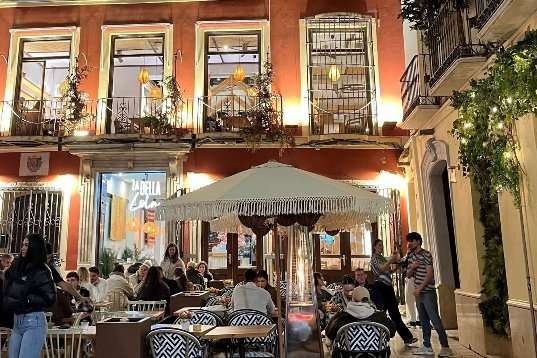
Malaga and Bournmouth
Maybe not quite able to rival Malaga's 300 days of sunshine a year, Bournemouth is a British holiday favourite with a reputation for sunshine and a temperate climate, claimed to be amongst the best in the UK.
Grand Victorian buildings are preserved alongside elegant 1920s Art Deco architecture and nostalgia is lovingly served from silver teapots in gracious hotel Palm Courts and continental style Cafes.
The Afternoon Tea Ritual, keenly observed, was invented in the 1840's by an aristocratic lady, the Duchess of Bedford, Anna Maria Russell, a confidant of Queen Victoria.
As a monument to Spanish and Moorish grandeur, over-looking central Malaga, towers the awesome 16th century Renaissance and baroque Cathedral Basilica de la Santa Iglesias de la Encarnacion and the fortification of Alcazaba, imposing and majestically situated high on a hill above the city.
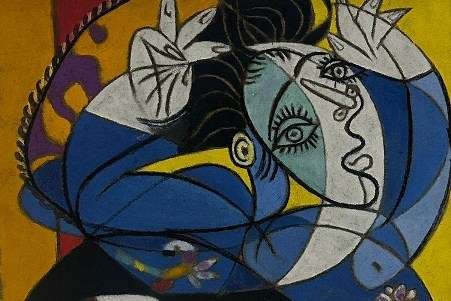
The Picasso Museum in his birth place of Malaga, is a major tourist attraction, alongside over 30 other city centre museums.
Bournemouth's landmark Castle ruins, date from the 11th Century and the Russell Cotes Art Gallery and Museum in the town centre offers culture and historic artefacts alongside art and scientific exhibits.
Malaga, a port city, is on the Mediterranean coast and Bournemouth boasts pride of place on the English channel with a view of cliffs and 7 miles of award-winning beaches.
Malaga is an international destination, a city of gentrified, European buildings, awe-inspiring churches and shiny marble streets with signature sculptures and sky-high flower structures, shaded by swaying palm trees on the wide-open polished marble and tiled pedestrianised walkways of the main street Calle Larios, Marques de Larios Street.
Eager to dance tango in an iconic Hispanic setting, the British dancers are all members of Tango Fandango, a 25-year established group led by professional dance teachers Brit Tracey Tyack-Acosta and her Argentinian husband, Leo Acosta.
They teach classic, authentic Argentinian tango andthe two are passionate about spreading knowledge of the art and culture of tango.
Over the years, the couple have taught hundreds of new and experienced tango dancers along the south coast and in London.
They also organize tango themed Dance Holidays in exotic locations, including Buenos Aires, home of tango: Vienna, a city of culture and classical music, and Spain, an ever-popular favourite.
Our group stayed at the Barcelo, a well-located modern four-star hotel, part of the complex that houses the Metro and Maria Zambrano railway station, from where local and high-speed trains run.
The hotel, surrounded by a multi-storey shopping Plaza, is 15 minutes' walkfrom Malaga city centre and yards from the ever-present pick-up point for open-top City tours.
First tango experience for the visiting dancers was as quests at a Milonga, the social dance get-togethers of the tango.
Tango has survived some 150 years as a popular art form since its early beginnings in the impoverished multi-cultural port districts of Buenos Aries, Argentina (where out teacher Leo was born and raised) and Montevideo, Uruguay.
Predominately a blend of African and Spanish-Cuban musical styles, tango was considered a lower-class dance before achieving international fame in Paris in the early 1900's, worldwide recognition followed.
Initially an urban folklore dance style, popular tango movements developed before and after the First World War.
The close sensual embrace ensured a questionable reputation until the good fortune of aHoly Intervention.
The story goes that the dance was presented to one of the Popes, he decreed it was 'not scandalous' and the tango's reputation was vindicated.
Music and lyrics transformed over the years and by the 1920s had become more melancholic and serious featuring the bandoneon (a type of concertina) supported by guitar, violin and piano in a variety of styles from slow and cat-like to super-fast setting the dance floor alight.
Complex leg movements and improvisation ensures that dancers generally train for years to achieve proficiency.
Globally tango dancers have a natural affinity for fellow lovers of the art and warmly welcome visitors into their close-knit communities.
The dance has survivedover the centuriesand basic tango etiquette is rigorously observed.Ladies must wait to be asked to dance.
The gentleman flashes an eye signal across the room and the lady nods assent for him to approach and lead her onto the wooden-sprung dance floor.
No self-respecting tango dance leader (inevitably male) allows himself to be humiliated by crossing a room to ask a lady to dance, only to be refused.
The men, displaying good manners and gentlemanly behaviour, take the arm of their lady partner as they lead her from her table into the line of dance and. at end of the dance, escort her back to her seat.
Tango dance music is grouped into three pieces – songs can be extremely short, just one to two minutes long, In between the group of three, special and distinctive non-tango music is played.
This allows a change of partners without embarrassment to either party.
The lady may decide she doesn't want to continue to dance with her partner and excuses herself to see who else may attempt to catch her eye.
Three dances may be more than enough and she's ready to move on from her partner who is already looking for his next conquest.
It is all very civil and as the milonga dance floor is often very crowded, decorum in executing fancy complex moves is encouraged.
No fancy show-stopping high kicks or disruptive flowing complex leg patterns.
Tango is a sensualdance, but not overtly sexual.Ladies dress in exotic figure-hugging outfits and men are expected to be well turned out, but the object is to show off dance techniques.
It is all about the dance, the musicality, the poetry of the lyrics, the history and the connection between partners to navigate their way around a room following unspoken leads and guidance.
Most dances are conducted in silence, thus offering respect to the music and the singing of highly accomplished and revered artists.
Our Best of British group of several couples, single ladies and solos, are all experienced dancers and hold their own dancing with the hosts, who welcome us warmly and reveal that tango tends to be passed down in families and dance has been a way of life since they were children.
There is a myth that men have to dance with other men for seven years before they are considered proficient enough to dance with ladies.
It may or may not be true! Dancing with other men is at the very root of the tango that began among Argentinian gauchos (cowboys).
Competition can break out between rivals as a display of physical fitness, maleness and strength.
Couples observe a divine space in tango and between partners conversation is almost non-existent, focusing instead on honouring the dance.
Tracey is quoted as saying, "Every woman deserves to be tangoed. Relax and enjoy it."
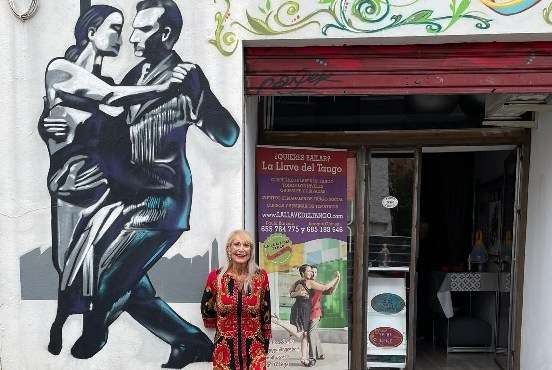
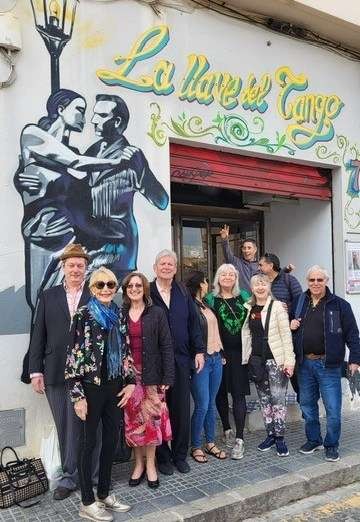
Leo and Tracy lead us through our paces at a purpose-built studio named La Llave del Tango (Key to the Tango), where we receive tips and directions on tango structures using the basic eight steps and eye-catching embellishments.
We attend classes in the morning and join the local dancers at milongas in the evening.A perfect opportunity to show off what we learn during the day.
Dancing our way through an enlightening and exhaustive 5-day bonding process we have plenty of time for sightseeing in the magnificent city of Malaga.
We prepare for pre-arranged queue-skipping visits to the the iconic Cathedral and the Picasso museum in his hometown of Malaga. One of two Picasso Museums, the other, the Natal, being at the place of his upbringing.
The principal, Museo Picasso Malaga is extravagantly housed in a 16th century restored palace, Palacio de Buenavistawith over 200 works of the Master on display including art, sculptures and ceramics.
A not-to-be missed experience
At part of our tango education, Tracey and Leo invite us to an Argentinian tapas bar on our first night and a breath-taking Flamenco performance followed by an Andalusian meal at El Gallo Ronco in the center of Malaga, on our last night.
A love of tango dancing, traditional dining, spectacular entertainment and great company with new friends in inspiring locations, tempts us to expend our high-energy, practicing our newly discovered advanced gyrations and high kicks.
After midnight, as we say reluctant 'goodbyes', ready to head to the airport the following day, we channel our excitement into a 'flash mob' on the beautiful shining marble streets of Malaga .
A dozen tango loving Brits pay tribute to the tango and dance together down the wide-open thoroughfare.Much to the delight of passers-by.
A feel-good experience to treasure on our amazing adventure Tango Dancing on the Costa del Sol.
More information :
Location (Map)
About the author

Contact info

ISSN 2634-7032
London, United Kingdom
+44 0 7764 198 286